For most of the SaaS era, software recorded work. It stored tickets, tracked transactions, logged conversations, and organized workflows. Intelligence sat outside the product in dashboards, analysts, and periodic reporting.
AI-native SaaS changes the direction entirely. The system does not only documents activity. It performs portions of the work itself.
Traditional SaaS integrates artificial intelligence as a feature layer. AI-native SaaS is built so that the core product behavior depends on machine learning models, real-time inference, and continuously updated data pipelines.
Remove the model, and the application no longer functions meaningfully. Remove AI from a CRM plugin, and the CRM still works.
Gartner’s 2024 application innovation research notes that enterprise software is moving from systems of record toward systems that act, where software initiates decisions and operational steps without human prompts.
The shift is already visible in categories like support automation, fraud prevention, developer tooling, and security operations.
Three technical characteristics appear consistently across high-rated platforms in SaaS review communities and enterprise analyst briefings.
First: Inference is embedded in workflows.
The model runs during the transaction, not after it. A support platform drafts responses before an agent reads the ticket. A finance system flags and routes a payment before approval workflows begin.
Second: The product learns from usage.
AI-native products improve from customer activity, not scheduled updates. The vendor ships the data infrastructure with the application. This is closer to an operating service than packaged software.
Third: The interface assumes prediction.
Users do not search or configure extensively. The system suggests, routes, writes, or blocks actions. In other words, the UI is organized around recommendations rather than menus.
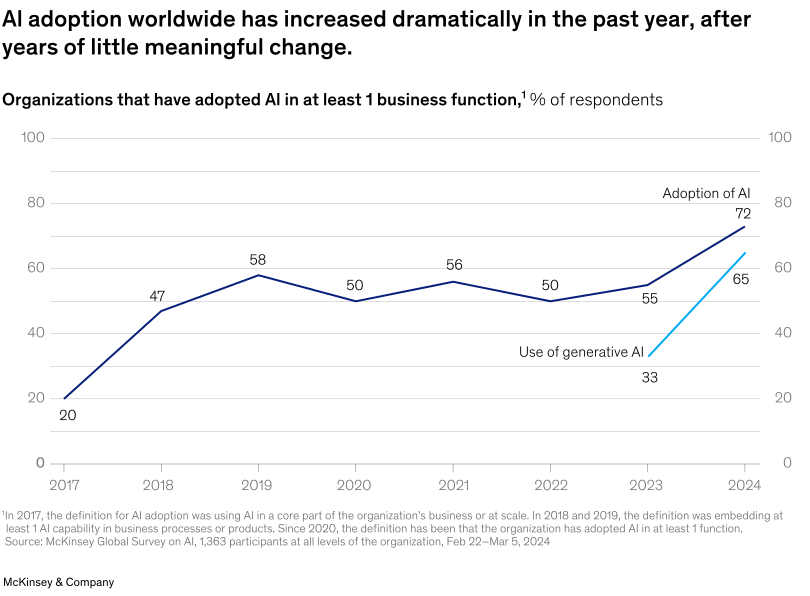
McKinsey’s State of AI report found that organizations using AI within core business processes, not peripheral analytics, were significantly more likely to report revenue impact and cost reduction.
The difference was not model sophistication. It was workflow integration.
Two forces converged in 2024 and 2025.
Foundation models became capable enough to perform knowledge work tasks. At the same time, cloud infrastructure costs for inference dropped as providers optimized GPU utilization and introduced specialized AI compute tiers.
That combination made it economically viable for vendors to let software take operational actions.
This has strategic implications for buyers.
First, implementation risk shifts. Historically, enterprises customized SaaS heavily. AI-native platforms resist deep customization because model behavior depends on standardized data structures. Adoption, therefore, becomes an operating-model decision, not an IT deployment.
Second, vendor lock-in increases. A company is no longer only buying features. It is adopting a trained decision system. Switching vendors means retraining workflows, not migrating records.
Third, workforce design changes. In customer support, for example, agents increasingly supervise conversations rather than write them. In cybersecurity, analysts validate alerts rather than discover them. Microsoft reported in its 2024 Work Trend Index that employees already spend significant time reviewing AI-generated output rather than creating first drafts.
Accuracy becomes a product dependency. If model performance degrades, operations degrade. Governance also becomes central. The organization must monitor model behavior, audit decisions, and define escalation rules. These are management functions, not IT tasks.
There is also a procurement challenge. Traditional SaaS evaluation focuses on feature coverage. AI-native evaluation requires testing decision quality, training transparency, and data isolation practices.
The SaaS transition of the 2010s digitized processes. The AI-native transition automates judgment inside those processes.
Enterprises are not merely buying better tools anymore. They are deciding which operational decisions they are comfortable delegating to software. That is why the category matters now.
Ready to elevate your sales function?
What is the difference between AI-native SaaS and traditional SaaS?
Why are enterprises adopting AI-native software now?
Does AI-native SaaS increase vendor lock-in?
How should companies evaluate an AI-native SaaS platform?
What risks should leadership consider before implementing AI-native SaaS?